

 เลือกภาษาไทย
 | | |
|
Thai เลือกภาษาไทย |

 F14 | ||
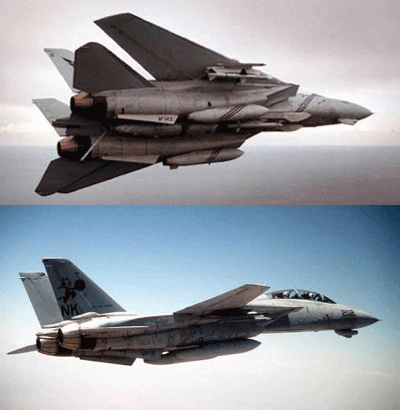
| GRUMMAN F -14 TOMCAT is a 2 seat, twin engine fighter with twin tails and variable sweep wing, supersonic designed to attack and destroy enemy aircraft
at night and all weather conditions. Grumman F-14 Tomcat would probably not even existed if it not had been for the failure of the General Dynamics F-111 and the requirement of replacing
F-4 Phantom . The first F-14A became airborne on 21 December 1970 . It consists of a long nacelle and two crew positions extending forward and above the engines . The engines are parallel to the central structure towards the tail . The wings
are programmed for automatic sweep during flight ,with a manual override provided. Normal sweep range is 20 to 68 degrees with a 75 degrees position provided for shipboard hangar
stowage only . The wing trailing edges are aligned with the leading edges of the horizontal tails. Sweep speed is 7.5 degrees per second . Wing sweep angle is automatically controlled ,
for takeoff and landing, as well as for low-speed flight, the wings are set at a minimum sweep 20 degrees. For supersonic , the wings sweep back to 68 degrees. The main landing gear
retract forward into wheel wells inside the wing box, rotating 90 degrees to lie flat . The nose wheel unit retracts forward into a well in the nose. The F-14 TOMCAT enterd the fleet in 1973 , replacing the F-4 PHANTOM II . F-14A incorporated with two Pratt & Whitney TF-30P-414A turbofan engine with afterburners. The F-14B introduced in November 1987, incorporated with new General Electric F110-GE-400 turbofan engines with afterburners. The F-14D , delivered in 1990, and was a major upgrade with F-110-GE-400 engines, new radar system , Infrared Search and Track (IRST) and a new digital flight control system. F-14 TOMCAT had a spin problem on its ability to engange successfully in a dogfight. The control system did not provide the pilot full control authority from spin and other departures, resulting in the loss of several aircraft and crews.In 1996 they loss three aircraft over a four week period. The new control was developed and succeeded which providing recoveries from spin including the change of analog Automatic Flight Control System (AFCS) to Digital Flight Control System (DFCS). F-14D TOMCAT is an advanced Tomcat derivertive that was developed in parallel with F-14A . Both variants were to be powered by General Electric F110-GE-400 turbofan ,which was designed to remedy some of the defects of the P&W TF30, particularly the problem with compressor stall. F-14D has a digital processing system which linking the avionics units together. The avionics of the F-14A were largely analog system. The Automatic Flight Control System (AFCS) will be replaced by Digital Flight Control System (DFCS). The first F-14D was delivered in February 1990 | ||
| SPECIFICATIONS F-14D SUPER TOMCAT | ||
| Power Plant (Turbofan with afterburners) |
F-14A use P&W , TF-30P-414A | F-14B, F-14D use GE , F-110-GE-400 |
| Number of Engine | 2 | |
| Engine Thrust | F-14A P&W (TF-30P-414A) 20,900 lb(9,405 kg) |
F-14B,F-14D GE (F-110-GE-400) 27,000 lb(12,150 kg) |
| Wing Span | 64 feet (19 m.) unswept | 38 feet (11.4 m.) swept |
| Length | 61 feet 9 inches | 18.6 m. |
| Speed | F-14A max.2.37 mach |
F-14D max. 1.88 mach , cruise 0.72 mach |
| Range(combat raduis) | 380 to 500 nm. | |
| Takeoff Weight | 72,900 lb (32,805 kg) | |
| Ceiling | above 53,000 ft. | |
| Crew | 1 pilot and 1 radar intercept officer | |
| Armament | ||
| Up to 13,000 lbs one MK-61A1 Vulcan 20 mm cannon |
air-to-air Missiles 6 AIM-7 Sparrows 4 AIM-9 Sidewinder 6 AIM-54 Phoenix |
air-to-ground Ordnance MK-82 (500 lb) , 4 MK-83 (1000 lb) Mk-84 (2000 lb) , MK-20 cluster bomb 4 GBU-10 lGB , GBU-12 MK-82 LGB 4 GBU-16 MK-83 LGB 4 GBU-24 MK-84 LGB |
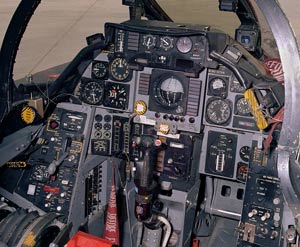 |
cockpit F-14 TOMCAT | |
| 1 nm.(nautical mile) = 1.15155 miles, 1 kt (knot) = 1.15155 mile / hr. 1 mach = 761 mph.(SL,ISA) |
||
 © 2002 Thai Technics.Com All Rights Reserved | ||
| Contact Webmaster | ||